Split AC vs Window AC – Which One Should You Choose?
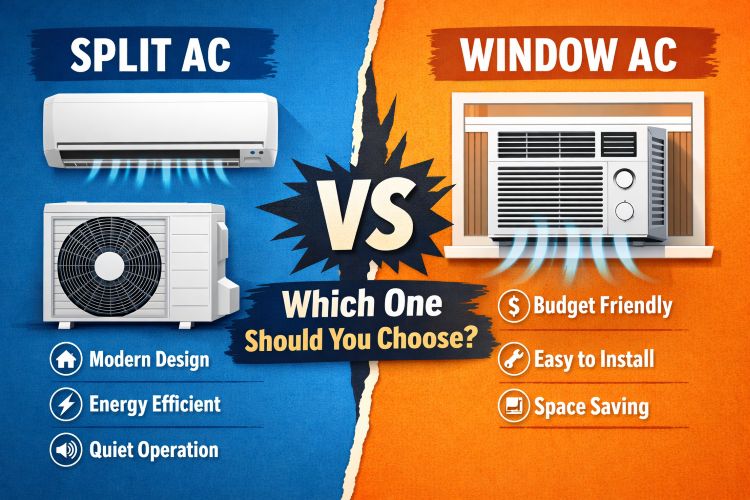
When summer temperatures soar, a reliable air conditioner becomes less of a luxury and more of a necessity. But standing in an appliance store — or scrolling through hundreds of online listings — you're quickly faced with one of the most common questions in home cooling:
Should I buy a Split AC or a Window AC? Which one is better for my home, budget, and lifestyle?
Both air conditioning types serve the same core purpose — cooling your indoor space — but they differ significantly in design, performance, cost, installation, and long-term value. This complete guide on split AC vs window AC covers everything you need to make a confident, informed decision.
What Is a Split AC?
A split air conditioner consists of two separate units:
- An indoor unit (evaporator/blower) — mounted on the wall inside your room
- An outdoor unit (compressor/condenser) — placed outside the building
The two units are connected by refrigerant pipes and electrical cables through a small hole in the wall. The indoor unit absorbs warm air, cools it over a refrigerant coil, and circulates it back into the room — while the outdoor unit expels the extracted heat outside.
Advantages of Split AC
- Sleek, modern, wall-mounted aesthetics
- Very quiet indoor operation (compressor stays outside)
- Highly energy-efficient — especially inverter models
- Excellent cooling for medium to large rooms
- Advanced features: WiFi control, air purifiers, sensors
- Longer lifespan — typically 15–20 years
Disadvantages of Split AC
- Higher upfront purchase price
- Professional installation required (drilling, piping)
- Installation cost adds $$200–$$800 on average
- Outdoor unit requires dedicated wall or floor space
What Is a Window AC?
A window air conditioner is a single self-contained unit housing all components — compressor, condenser, evaporator, and blower — within one box. It is designed to fit into a standard window frame or a hole cut into an exterior wall.
Advantages of Window AC
- Lower upfront purchase price
- Simple, DIY-friendly installation
- No separate outdoor unit required
- Easy to service and maintain
- Ideal for small rooms and apartments
- Relatively portable — can be moved between rooms
Disadvantages of Window AC
- Noisier — all components including compressor are inside
- Blocks natural light and window view
- Less energy-efficient (mostly non-inverter)
- Limited placement options (window or wall cutout only)
- Less powerful for large rooms
Split AC vs Window AC — Head-to-Head Comparison
| Feature | Split AC | Window AC | Winner |
|---|---|---|---|
| Upfront Cost | 500–500–2,000+ | 150–150–700 | 🏅 Window AC |
| Installation Cost | 200–200–800 | 0–0–150 | 🏅 Window AC |
| Energy Efficiency | ⭐⭐⭐⭐⭐ (Inverter) | ⭐⭐⭐ | ✅ Split AC |
| Noise Level | Very Low (18–35 dB) | Moderate–High (50–65 dB) | ✅ Split AC |
| Cooling Capacity | Excellent (all sizes) | Good (small–medium rooms) | ✅ Split AC |
| Aesthetics | Sleek & modern | Bulky, window-blocking | ✅ Split AC |
| Installation Ease | Complex (professional) | Simple (DIY possible) | 🏅 Window AC |
| Maintenance | Moderate | Easy | 🏅 Window AC |
| Smart Features | WiFi, app control | Basic remote/timer | ✅ Split AC |
| Air Quality | Advanced filters | Basic filters | ✅ Split AC |
| Portability | Fixed installation | Can be relocated | 🏅 Window AC |
| Lifespan | 15–20 years | 8–12 years | ✅ Split AC |
| Long-Term Savings | Higher (lower bills) | Lower | ✅ Split AC |
Energy Efficiency — A Closer Look
Energy efficiency is one of the most important factors in the split AC vs window AC debate, especially with rising electricity costs worldwide.
Split AC — Inverter Technology Edge
Most modern split ACs feature inverter compressor technology, which modulates compressor speed based on cooling demand rather than switching fully ON/OFF. Key benefits include:
- 30–50% lower electricity consumption vs. non-inverter units
- Faster cooling with consistent temperature maintenance
- Reduced compressor wear, extending the unit's lifespan
Window AC — Traditional Compressor
Most window ACs use fixed-speed compressors that cycle ON/OFF to maintain temperature, consuming more power and causing slight temperature fluctuations. While some newer models offer inverter tech, they remain less common.
Pro Tip: Always check the EER (Energy Efficiency Ratio) or SEER (Seasonal EER) rating before purchasing. A higher number means lower electricity bills.
Noise Levels — Which Is Quieter?
| AC Type | Noise Level | Comparison |
|---|---|---|
| Split AC (Indoor Unit) | 18–35 dB | Rustling leaves 🍃 |
| Window AC | 50–65 dB | Normal conversation 🗣️ |
The split AC's compressor is outside, making the indoor unit whisper-quiet — a major advantage for bedrooms, home offices, and nurseries. Window ACs place all components (including the loud compressor) inside the room, resulting in noticeably more noise.
Total Cost of Ownership (10-Year Estimate)
| Cost Factor | Split AC | Window AC |
|---|---|---|
| Purchase Price | 600–600–2,000 | 200–200–700 |
| Installation | 200–200–800 | 0–0–150 |
| Annual Electricity Cost | ~150–150–300/yr | ~250–250–500/yr |
| Annual Maintenance | 50–50–120 | 30–30–80 |
| Lifespan | 15–20 years | 8–12 years |
| 10-Year Total Estimate | ~3,500–3,500–6,000 | ~3,000–3,000–6,500 |
Key Insight: While a Window AC is cheaper to buy, a Split AC's energy savings over a decade can make the total cost comparable or even lower — especially with an inverter model.
Room Size Guide — Which AC Fits Your Space?
| Room Size | BTU Required | Recommended Type |
|---|---|---|
| Up to 150 sq ft | 5,000–6,000 BTU | ✅ Window AC (ideal) |
| 150–250 sq ft | 6,000–8,000 BTU | ✅ Either works well |
| 250–400 sq ft | 9,000–12,000 BTU | ✅ Split AC (preferred) |
| 400–600 sq ft | 14,000–18,000 BTU | ✅ Split AC (recommended) |
| 600+ sq ft | 18,000+ BTU | ✅ Split AC / Multi-split |
Final Verdict — Who Should Choose What?
There is no single "best" answer. The right choice depends entirely on your space, budget, and priorities.
Choose a Split AC If…
- You want ultra-quiet operation (bedroom, office)
- Your room is larger than 250 sq ft
- You want long-term energy savings
- You care about sleek design and aesthetics
- You need smart/advanced features
- You're in a permanent residence
- Better air quality features matter to you
Choose a Window AC If…
- You have a tight upfront budget
- You're in a rental or temporary space
- Your room is small (under 250 sq ft)
- You prefer simple, DIY installation
- You have no space for an outdoor unit
- You need cooling only occasionally
- You need the flexibility to move the unit
Conclusion
Both the Split AC and Window AC are excellent cooling solutions — each designed for different users and needs. If you prioritize efficiency, silence, and long-term performance, the Split AC is the clear winner. If you value affordability, simplicity, and flexibility, the Window AC delivers excellent value.
Use the comparison tables and room size guide in this article as your personal checklist, compare EER ratings on the models you shortlist, and you'll be well on your way to a cooler, more comfortable home.
Need help with your appliances? EssenTechs offers the best AC repair in Kerala, washing machine repair, refrigerator repair & service, and microwave oven repair. Call us now!
Call Now for Service EssenTechs


